Which Treatment Is Right for Your Spine, Neck or Brain?
If you’re living with back pain, neck pain, numbness or a diagnosis that has you worried, you probably want to know one thing: what are my options? At American Neurospine Institute in Frisco, TX, we start with the most conservative care that can realistically help. When surgery is the better path, we use minimally invasive and computer-assisted techniques. If you’ve been searching for a neurosurgeon near me who will explain every choice before you decide, we’d be glad to meet you.
Request an AppointmentWhat Treatments Does a Neurosurgeon Offer?
A neurosurgeon diagnoses and treats conditions of the spine, spinal cord, nerves and brain. That covers non-surgical care such as physical therapy, spinal bracing, facet block injections and pain management. It also covers surgical care, from small decompression procedures to complex reconstruction. Most patients who come to us never need an operation. Our job is to find the treatment that fits your diagnosis, your goals and your daily life.
Do I Have to Try Non-Surgical Care First?
For most spine conditions, yes. Rest, targeted exercise, medication, cryotherapy and injections often calm inflamed nerves and joints enough to restore comfort and function. Our non-surgical care options are designed to give your body a real chance to heal first. Some situations call for surgery sooner, such as progressive weakness, loss of bladder or bowel control, spinal cord compression or an unstable fracture.
What Surgical Options Are Available in Frisco?
When surgery makes sense, our team performs a full range of procedures, including:
- Minimally invasive surgery through small incisions for less tissue disruption and a faster return to activity
- Laminotomy and laminectomy and foraminotomy to relieve pressure on compressed nerves
- Lumbar disc microsurgery and laser disc repair for problem discs
- Spinal fusion, including ACDF, ALIF, OLIF and TLIF
- Motion preservation and disc replacement as an alternative to fusion for select patients
- Kyphoplasty and balloon vertebroplasty for painful compression fractures
- Sacroiliac (SI) joint fusion for stubborn SI joint pain
- Spinal deformity and scoliosis correction
- Revision spine surgery when a previous operation hasn’t delivered relief
- Spinal cord and dorsal column stimulators for chronic nerve pain
- Craniotomy and brain tumor care
How Does Technology Make Surgery Safer?
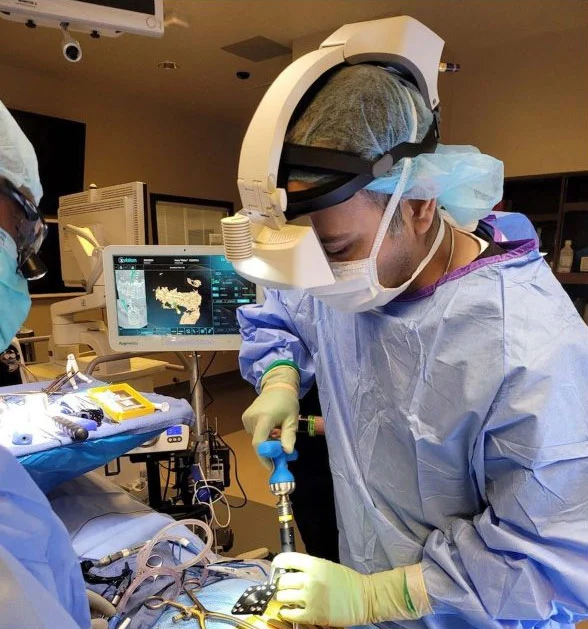
Our computer-assisted neurosurgery uses real-time imaging and navigation to guide implants and instruments with precision. For many patients, that means smaller incisions, less blood loss, shorter hospital stays and a quicker recovery. You can learn more on our advanced surgical technology page, or see the full overview of spine surgery options we offer.
How Do I Know Which Treatment I Need?
It starts with an accurate diagnosis. During your visit, we review your symptoms, examine your strength, reflexes and sensation, and study your imaging. Then we walk you through every reasonable option, including what happens if you wait. Before your appointment, take a look at what to expect at your first visit and our new patient information, or meet our providers.
Treatment Options
- Bracing
- Computer-Assisted Surgery
- Cryotherapy
- Facet Block Injection
- Foraminotomy
- Laminectomy
- Laser Disc Repair
- Minimally Invasive Surgery
- Motion Preservation/Disc Replacement
- Physical Therapy
- Pain Management
- Revision Surgery
- Sacroiliac (SI) Fusion
- Spinal Cord/Dorsal Column Stimulators
- Spinal Deformity/Scoliosis Correction
- Spinal Fusion
- Spinal Surgery
In Addition, We Also Treat:
- Adjacent Segment Disease
- Annular Tear
- Arthritis of the Spine
- Back Pain
- Bone Spurs
- Bulging Discs
- Canal Stenosis
- Chronic Pain
- Compression Fractures
- Degenerative Disc Disease
- Degenerative Spinal Disease
- Foraminal Narrowing
- Instrumentation Failure
- Kyphosis
- Leg Pain
- Headaches
- Nerve Root Impingement
- Pinched Nerve
- Prolapsed Disc
- Radiculopathy
- Ruptured Disc
- Sacroiliitis
- Spinal Narrowing
- Spondylitis
- Spondylolisthesis/Pars Defect
- Sports Injuries
- Torn Disc
For brain and spinal cord conditions such as cervical myelopathy, Chiari malformation and brain tumors, visit our conditions we treat page.
What Do Patients Ask Most About Neurosurgery Treatment?
Do most people with back or neck pain need surgery?
No. Most people with back or neck pain improve with non-surgical care such as physical therapy, medication, bracing or injections. Surgery is usually considered only when conservative treatment hasn’t helped, or when there are signs of nerve or spinal cord damage such as weakness or numbness that keeps getting worse.
What is minimally invasive spine surgery?
Minimally invasive spine surgery uses small incisions, specialized instruments and imaging guidance to reach the spine while moving muscles aside instead of cutting through them. Many patients have less pain after surgery, a shorter hospital stay and a faster return to normal activities than with traditional open surgery.
How do I find a neurosurgeon near me in Frisco?
Our office is at 13136 Dallas Parkway, Suite 540A, in Frisco, TX, and we see patients from across Collin and Denton counties. You can call (972) 806-1188 or request an appointment online. We’re open Monday through Friday from 8 a.m. to 5 p.m.
Is disc replacement an alternative to spinal fusion?
For some patients, yes. Artificial disc replacement removes a damaged disc and replaces it with a device that allows the spine to keep moving, while fusion joins two vertebrae permanently. Whether you’re a candidate depends on your age, bone quality, the level involved and whether there is arthritis or instability at that segment.
What if my previous back surgery didn’t work?
Ongoing pain after spine surgery can come from a new disc problem, scar tissue, a fusion that didn’t heal, hardware issues or breakdown at the level next to a fusion. We evaluate what’s causing the symptoms and discuss options that range from injections and spinal cord stimulation to revision surgery.
How long is recovery after spine surgery?
Recovery depends on the procedure. Many people return to light activity within a few days to two weeks after a minimally invasive decompression. Spinal fusion typically takes several months for the bone to heal fully, though most patients are walking the same or next day and gradually rebuild strength with physical therapy.
Do I need a referral to see a neurosurgeon?
It depends on your insurance plan. Some plans require a referral from your primary care doctor and others don’t. Our staff can help you check your coverage, and bringing any recent MRI, CT or X-ray reports to your first visit helps us move toward a diagnosis faster.
Ready to Talk Through Your Options?
You don’t have to figure out the next step on your own. Our team will take the time to explain your diagnosis and help you choose a treatment plan you feel confident about. Call (972) 806-1188 or request your visit with American Neurospine Institute today.
