
Is a Slipped Vertebra Behind Your Back and Leg Pain?
If your lower back aches when you stand, your legs feel heavy or tingly when you walk, or your hamstrings stay tight no matter how much you stretch, a vertebra may have shifted out of place. That’s spondylolisthesis, and at American Neurospine Institute in Frisco, TX, our neurosurgeons start by finding out exactly how far the bone has slipped and whether it’s pressing on nerves. Many patients improve with therapy, bracing or injections. When the spine is unstable, we offer minimally invasive stabilization designed to get you back on your feet. Call (972) 806-1188 to talk with a spine specialist near you.
Request an AppointmentWhat Is Spondylolisthesis?
Spondylolisthesis is a spinal condition in which one vertebra slides forward over the vertebra below it. It most often happens in the lower back, usually at L4–L5 or L5–S1. The slip can narrow the spinal canal and the openings where nerves exit the spine, which leads to lower back pain, leg pain and nerve symptoms. It is one of the most common conditions we see in our back conditions practice.
What Causes a Vertebra to Slip?
Spondylolisthesis isn’t one condition with one cause. The type you have shapes your treatment plan:
- Degenerative spondylolisthesis: The most common type in adults over 50. Worn discs and arthritic facet joints loosen their grip on the vertebra, often alongside degenerative disc disease and spinal arthritis.
- Isthmic spondylolisthesis: A stress fracture in a thin bridge of bone called the pars interarticularis (spondylolysis) allows the vertebra to slide. It often starts in teens and young athletes who arch the back repeatedly, which is why we see it in sports injury patients.
- Congenital (dysplastic) spondylolisthesis: A difference in how the spine formed at birth.
- Traumatic spondylolisthesis: An acute fracture from a fall, crash or high-impact injury.
- Pathologic spondylolisthesis: Bone weakened by osteoporosis, infection or a tumor.
- Post-surgical spondylolisthesis: Instability that develops after a prior spine operation, sometimes requiring revision spine surgery.
What Does Spondylolisthesis Feel Like?
Some people with a mild slip feel nothing at all. Others notice:
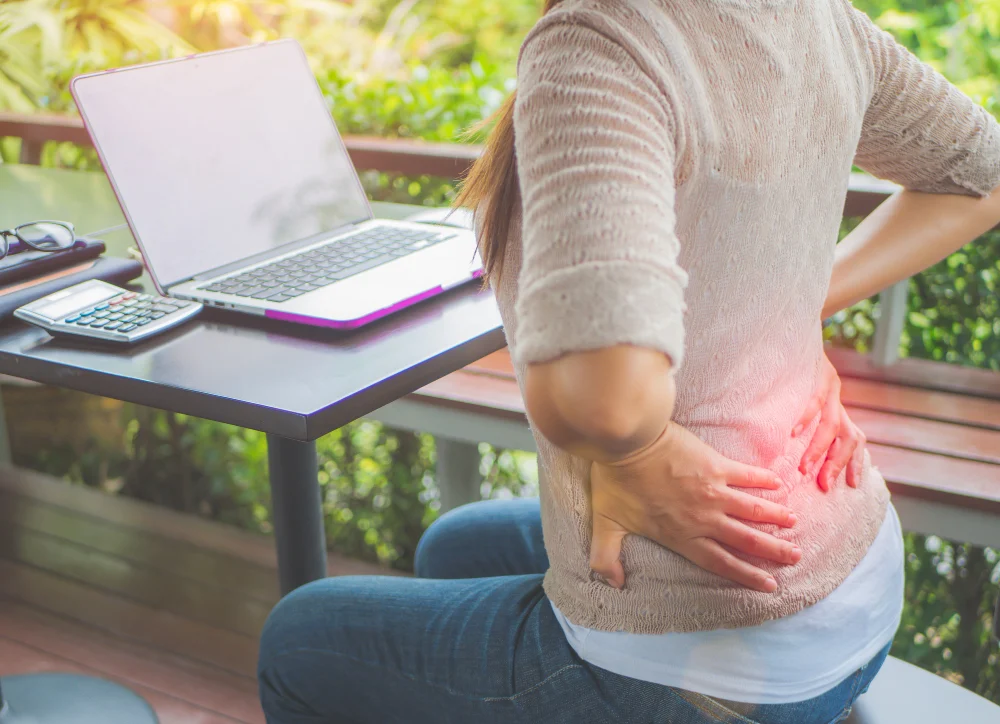
- Lower back pain that worsens when standing, walking or leaning backward and eases when sitting or bending forward
- Pain, numbness or tingling that travels into the buttocks and legs, similar to sciatica
- Tight hamstrings and a change in posture or gait
- Leg fatigue or heaviness while walking, a sign of spinal stenosis
- Weakness in the legs or feet from a pinched nerve
Loss of bladder or bowel control, numbness in the groin or rapidly worsening leg weakness needs emergency care right away.
How Do We Grade a Slip?
We use the Meyerding scale, which measures how far the upper vertebra has moved forward. Grade I is a slip of up to 25%, Grade II is 26–50%, Grade III is 51–75%, Grade IV is 76–100% and Grade V (spondyloptosis) means the vertebra has slipped completely off the one below. Most adults have Grade I or II. Along with the grade, we check flexion and extension X-rays to see whether the vertebra moves when you bend, and an MRI to see whether nerves are being squeezed.
How Is Spondylolisthesis Treated Without Surgery?
Most low-grade slips respond to conservative care. Your plan may combine targeted physical therapy to strengthen the core and loosen tight hamstrings, short-term activity changes, anti-inflammatory medication and a custom spinal brace, which is especially helpful for young athletes with a fresh pars fracture. For nerve pain that lingers, our pain management options, including epidural and facet block injections, can calm inflammation so you can stay active in rehab.
When Does Spondylolisthesis Need Surgery?
Surgery is considered when months of conservative care haven’t helped, when the slip is high-grade or getting worse, when the vertebra is unstable on motion X-rays, or when nerve compression causes weakness or trouble walking. The goal is to take pressure off the nerves and hold the spine in a stable position.
Which Surgical Options Do We Offer?
- Decompression: A laminotomy or laminectomy removes bone and thickened ligament pressing on nerves.
- Spinal fusion: Spinal fusion joins the slipped vertebra to the one below so it can no longer shift.
- TLIF: Transforaminal lumbar interbody fusion decompresses and fuses through a single approach from the back.
- OLIF and ALIF: Oblique and anterior lumbar interbody fusion reach the spine from the side or front, which can restore disc height and help realign the slip.
Whenever possible, our surgeons use minimally invasive surgery and computer-assisted navigation for smaller incisions, accurate screw placement and a quicker return home.
Why Choose Our Frisco Spine Team?
Dr. Ripul Panchal and Dr. Joshua Crooks are neurosurgeons who treat the full range of spine conditions, from first-time back pain to complex reconstruction. Because we offer both non-surgical and surgical care under one roof, we don’t push you toward an operation you don’t need. Patients searching for a spondylolisthesis specialist near me come to us from Frisco, Plano, McKinney, Prosper and across North Texas. Learn what to expect at your first visit.
Questions Patients Ask About Spondylolisthesis
Can spondylolisthesis heal on its own?
A slipped vertebra usually doesn’t move back into place on its own, but symptoms often settle with physical therapy, activity changes and time. In teens with a new pars stress fracture, bracing and rest can allow the bone to heal before the slip progresses.
Will my spondylolisthesis get worse over time?
Most low-grade adult slips stay stable for years. Progression is more likely in growing children, in higher-grade slips and when the vertebra moves on bending X-rays. We monitor with periodic imaging so changes are caught early.
What activities should I avoid with spondylolisthesis?
Activities that arch the lower back or load it heavily, such as gymnastics back walkovers, heavy overhead lifting and contact sports, can aggravate symptoms. Walking, swimming, stationary cycling and core strengthening are usually well tolerated. Your therapist will tailor a program to your grade and symptoms.
Is spondylolisthesis the same as a herniated disc?
No. Spondylolisthesis is a shift of the bone itself, while a herniated disc is the soft center of a disc pushing out through its outer ring. Both can pinch nerves and cause similar leg pain, and they can occur together, which is why an MRI is so helpful.
How long is recovery after fusion for spondylolisthesis?
Most patients walk the day of or the day after surgery and return to desk work in about 2 to 6 weeks. Lifting and strenuous activity are limited for roughly 3 months, and the bone fusion continues to solidify over 6 to 12 months.
Do I need a referral to see a neurosurgeon for spondylolisthesis?
Many insurance plans let you schedule directly, while some HMO plans require a referral. Our office can check your coverage when you call (972) 806-1188.
Where can I find spondylolisthesis treatment near me in Frisco?
American Neurospine Institute is located at 13136 Dallas Parkway, Suite 540A, in Frisco, TX, and is open Monday through Friday from 8AM to 5PM. We see patients from Frisco, Plano, McKinney, Allen, Prosper, Little Elm and surrounding communities.
Ready to Stand, Walk and Move With Less Pain?
A slipped vertebra doesn’t have to limit your life. Call American Neurospine Institute at (972) 806-1188 or request an appointment online to find out where your spine stands and which treatment fits you best. You can also browse every condition we treat.
