Is a Tight Nerve Opening Sending Pain Down Your Arm or Leg?
Pain that shoots from your neck into your hand, or from your lower back down your leg, may mean a nerve is being squeezed as it leaves your spine. If you’ve been searching for a foraminal narrowing specialist near me in Frisco, TX, American Neurospine Institute can help. Our neurosurgeons find the exact level that’s pinched and start with the most conservative care that fits your case. When surgery makes sense, we offer advanced minimally invasive options. Call (972) 806-1188 to schedule an evaluation.
Request an AppointmentWhat Is Foraminal Narrowing?
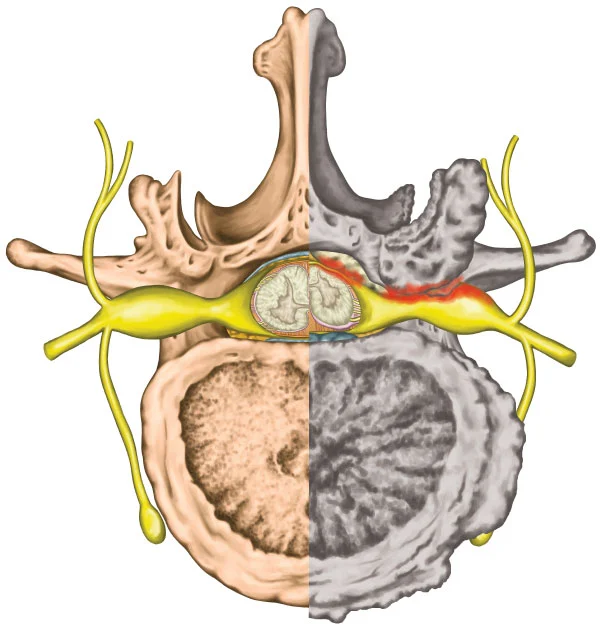
Foraminal narrowing, also called foraminal stenosis, means the small openings between your vertebrae have become too tight. These openings are called neural foramina, and spinal nerve roots pass through them on their way to your arms, legs and trunk. When an opening narrows, the nerve inside can be compressed or irritated. This causes pain, numbness, tingling or weakness along that nerve’s path. Foraminal narrowing is one form of spinal stenosis. It is different from central canal stenosis, which narrows the main channel that holds the spinal cord.
What Causes the Nerve Openings to Narrow?
Most foraminal narrowing develops slowly as the spine ages, but injury and other spine conditions can speed it up. Common causes include:
- Degenerative disc disease: discs lose height, so the openings between vertebrae get smaller.
- Bone spurs: extra bone forms around worn joints and crowds the nerve.
- Herniated discs: disc material bulges into the foramen.
- Spinal arthritis: enlarged facet joints and thickened ligaments take up space.
- Spondylolisthesis: one vertebra slips forward and changes the shape of the opening.
What Does Foraminal Narrowing Feel Like?
Symptoms depend on which nerve is pinched. Narrowing in the neck (cervical) usually affects the shoulder, arm and hand. Narrowing in the lower back (lumbar) usually affects the buttock, leg and foot. Many patients notice:
- Sharp, burning or electric pain that travels into an arm or leg
- Numbness or pins-and-needles in the hand, fingers, leg or foot
- Weakness, such as trouble gripping or a foot that catches when you walk
- Neck pain or lower back pain that gets worse when you lean back or turn toward the painful side
These symptoms are often described as radiculopathy, a pinched nerve or nerve root impingement. In the lower back, they can feel like sciatica.
How Do Our Frisco Neurosurgeons Diagnose It?
Your visit starts with a conversation about your symptoms and a hands-on neurological exam that checks strength, reflexes and sensation. Imaging, usually MRI and sometimes X-rays or CT, shows which opening is tight and what is narrowing it. Matching your exam findings to your images helps us treat the nerve that is actually causing your pain.
How Is Foraminal Narrowing Treated Without Surgery?
Most people improve without an operation, so we begin with conservative care. Your plan may include:
- Physical therapy to strengthen supporting muscles, improve posture and open space around the nerve
- Anti-inflammatory medication and activity changes during flare-ups
- Pain management, including targeted spinal injections that calm nerve inflammation
- Facet block injections when arthritic joints add to the pain
When Is Surgery the Right Choice?
We may recommend surgery if pain keeps limiting your life after a fair trial of conservative care. Surgery also becomes more urgent if weakness is getting worse or if numbness is spreading. Our neurosurgeons favor minimally invasive surgery whenever it fits your anatomy. Options include:
- Foraminotomy: widening the nerve opening by removing the bone or tissue that presses on the nerve
- Laminotomy or laminectomy: relieving pressure from the back of the spine
- ACDF for cervical narrowing caused by a disc or bone spur
- Spinal fusion when the segment is also unstable
Not sure whether you need an operation? Read Do I really need spine surgery? or browse our patient FAQs.
Why Do Patients Choose American Neurospine Institute?
Patients from Frisco and nearby communities such as Plano and McKinney come to see Dr. Ripul Panchal and our neurosurgery team. They value clear explanations, a conservative-first approach and surgical expertise when it’s truly needed. Learn more about why patients trust our practice.
What Do Patients Ask About Foraminal Narrowing?
Is foraminal narrowing the same as a pinched nerve?
Foraminal narrowing is one of the most common causes of a pinched nerve. The tight opening presses on the nerve root as it exits the spine, which causes pain, numbness or weakness along that nerve.
Can foraminal narrowing get better on its own?
The narrowed opening itself usually doesn’t widen without treatment. Even so, nerve inflammation often settles, and many people feel much better with physical therapy, medication and injections. Some never need surgery.
What makes foraminal narrowing pain worse?
Leaning backward, turning or tilting toward the painful side, and standing or walking for a long time can further narrow the opening and increase symptoms. Bending slightly forward often brings relief.
How long does it take to recover from a foraminotomy?
Many patients go home the same day or the next day after a minimally invasive foraminotomy. Light activity usually resumes within a few weeks. Full recovery varies by the level treated and your overall health.
Is foraminal narrowing in the neck dangerous?
Cervical foraminal narrowing mainly affects a single nerve root and usually isn’t an emergency. Get prompt care if you have worsening arm weakness, trouble with balance or hand coordination, or loss of bladder or bowel control.
Where can I find a foraminal narrowing specialist near me in Frisco?
American Neurospine Institute is at 13136 Dallas Parkway, Suite 540A, in Frisco, TX. We see patients Monday through Friday, 8AM to 5PM. Call (972) 806-1188 to book an evaluation.
Do I need a referral to see a neurosurgeon for foraminal narrowing?
Referral requirements depend on your insurance plan. Our team can help you check your coverage when you call to schedule.
Ready to Take Pressure Off the Nerve?
You don’t have to keep living with radiating pain, numbness or weakness. Our neurosurgeons in Frisco, TX will find what’s narrowing your nerve opening and build a plan to relieve it. Call (972) 806-1188 or request your appointment online.
