New Pain Above or Below Your Fusion? It Has a Cause
You had spine surgery, and it helped. Months or years later, you notice new pain, stiffness, or tingling near the same area. That pattern often points to adjacent segment disease, which means wear on the spinal levels next to a fusion. At American Neurospine Institute in Frisco, TX, Dr. Ripul Panchal finds out exactly which level is causing the trouble. He starts with the gentlest treatment that can work, and he offers revision surgery only when it is truly needed. If you’re searching for an adjacent segment disease specialist near me, call (972) 806-1188 to talk with our team.
Request an AppointmentWhat Is Adjacent Segment Disease?
Adjacent segment disease (ASD) is the breakdown of the spinal discs, joints, or ligaments directly above or below a level that was fused or operated on. A fusion stops motion at the treated level. The segments next to it then carry more of the load and movement, and over time they can wear down. This wear can cause a disc to bulge or herniate. It can also enlarge the facet joints or narrow the space around the nerves.
ASD can develop after a lumbar fusion such as a TLIF, an ALIF, or an OLIF. It can also follow a neck procedure such as an anterior cervical discectomy and fusion (ACDF). Normal aging adds to the problem, so not every case comes from the surgery itself. That is why an accurate diagnosis matters before any treatment decision.
Is Adjacent Segment Disease the Same as Failed Back Surgery?
No. They are different problems. Failed back surgery syndrome describes ongoing pain at or around the original operation. Adjacent segment disease is a new problem at a neighboring level. It usually appears after a period of relief. Some patients have other surgical issues as well, such as loosened screws or a fusion that never fully healed. Dr. Panchal checks for these during the same evaluation. Learn more about spinal instrumentation failure.
What Symptoms Should I Watch For?
- New or returning pain: Back or neck pain that comes back after a stretch of feeling better.
- Radiating pain: Pain that travels into the buttock, leg, shoulder, or arm, a pattern called radiculopathy.
- Numbness or tingling: Pins and needles in the hands, feet, arms, or legs.
- Weakness: Trouble gripping, lifting the foot, or climbing stairs.
- Reduced mobility: Stiffness that makes bending, turning, or daily tasks harder.
- Walking tolerance changes: Leg heaviness or cramping when standing or walking, which can be a sign of spinal stenosis.
How Do We Diagnose Adjacent Segment Disease?
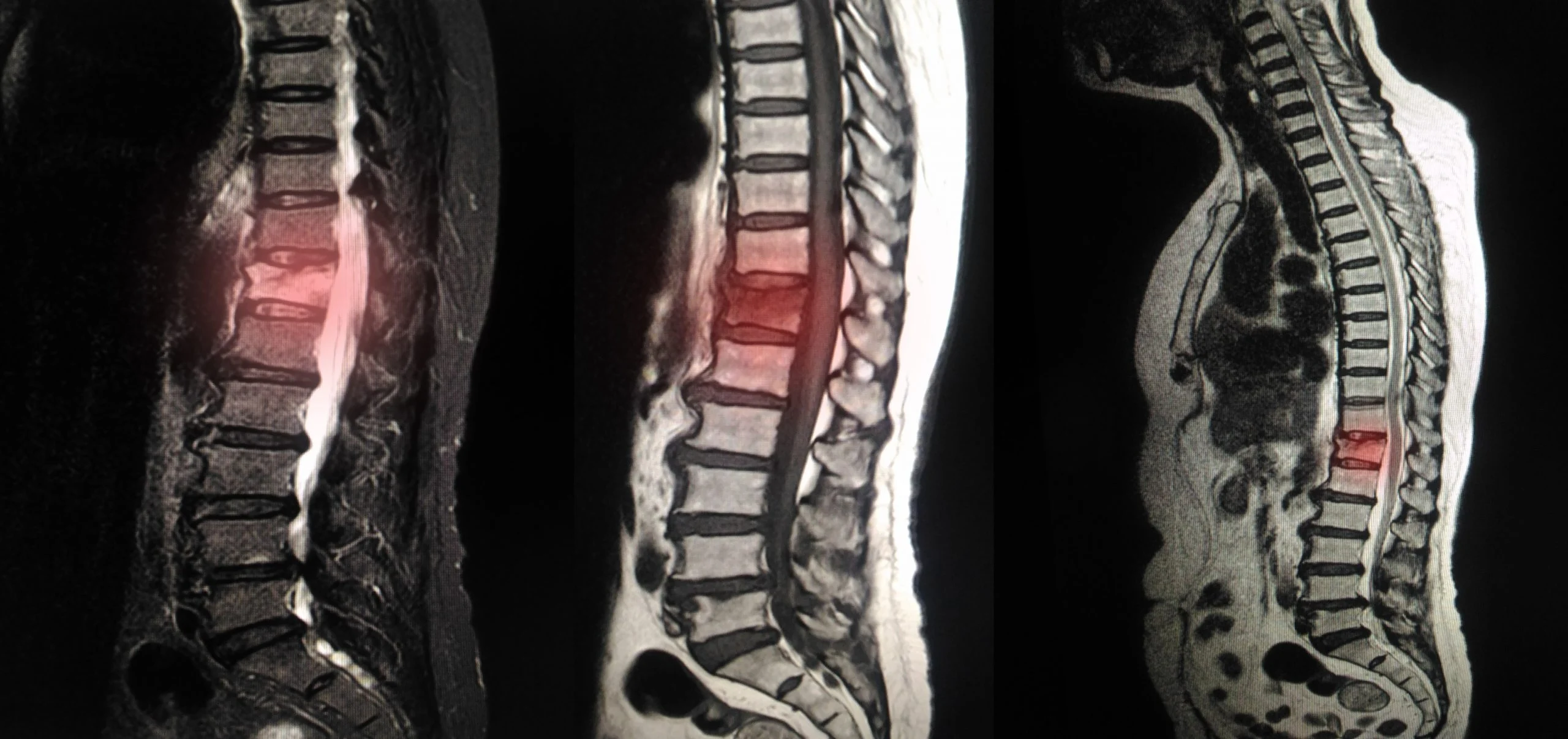
Dr. Panchal starts with a detailed history and a neurological exam. He then reviews your prior operative records and compares new imaging with your earlier scans. Upright X-rays, including flexion and extension views, show instability or slippage such as spondylolisthesis. MRI shows disc changes and nerve compression. CT scans confirm whether the original fusion has healed. Comparing these studies shows which level is causing the symptoms. It also shows whether the problem is a disc, a joint, or foraminal narrowing pinching a nerve root.
How Is Adjacent Segment Disease Treated in Frisco?
Many patients improve without another operation. Your plan depends on your symptoms, your imaging, and how your nerves are working.
Non-Surgical Options
- Physical therapy to strengthen the core and improve how load is shared across the spine.
- Anti-inflammatory medication and activity changes during flare-ups.
- Facet block injections to calm painful joints at the affected level.
- Coordinated pain management for longer-lasting symptom control.
- Short-term spinal bracing in selected cases.
When Is Surgery Considered?
Surgery is considered when nerve compression causes progressive weakness. It is also an option when pain stays severe after several months of conservative care, or when the segment has become unstable. In these cases, revision spine surgery can relieve pressure on the nerves and restore stability. Depending on your anatomy, this may involve decompression alone, such as a laminotomy or laminectomy. It may also involve extending the fusion to include the worn level. For some patients, motion preservation and disc replacement may be an option that avoids adding another fused level.
Dr. Panchal uses minimally invasive techniques and computer-assisted navigation whenever they fit the case. These approaches can reduce muscle disruption and support a smoother recovery. You can read more about his background on Dr. Ripul R. Panchal’s profile.
Why See a Neurosurgeon Near Me for Adjacent Segment Disease?
Treating a spine that has already been operated on takes experience with scar tissue, existing hardware, and complex alignment. Our Frisco team handles both first-time and revision procedures. We will explain every option, including whether waiting is the right call. Patients from Frisco and nearby communities, including Plano, McKinney, and Prosper, come to us for second opinions and long-term spine care. To see related problems we treat, visit our conditions we treat page.
Questions Patients Ask About Adjacent Segment Disease
What causes adjacent segment disease after spinal fusion?
When one level of the spine is fused, the levels next to it handle more motion and stress. Over time, this extra load can speed up disc and joint wear. Natural aging also plays a role, so the fusion is often one of several contributing factors.
How soon after surgery can adjacent segment disease appear?
It usually develops years after a fusion, not weeks. Many patients have a long period of relief before new symptoms begin. Pain that starts right after surgery more often has a different cause, which your neurosurgeon can identify.
Can adjacent segment disease be treated without another surgery?
Yes, in many cases. Physical therapy, anti-inflammatory medication, injections, and pain management often control symptoms well. Surgery is generally reserved for progressive nerve problems, instability, or pain that does not respond to conservative care.
Does adjacent segment disease happen in the neck as well as the lower back?
Yes. It can occur after a cervical fusion such as an ACDF, as well as after a lumbar fusion. Neck cases often cause arm pain, numbness, or weakness. Lower back cases more often cause leg symptoms.
What does revision surgery for adjacent segment disease involve?
It depends on what the imaging shows. Options include decompressing the pinched nerves, extending the fusion to the affected level, or in select patients, a motion-preserving procedure. Dr. Panchal will explain which approach fits your spine and why.
Can disc replacement lower the risk of adjacent segment disease?
Disc replacement keeps motion at the treated level. This may reduce stress on nearby segments for some patients, especially in the neck. Not everyone is a candidate, so your anatomy and the condition of your spine guide this decision.
Where can I find an adjacent segment disease specialist near me in Frisco?
American Neurospine Institute is located at 13136 Dallas Parkway, Suite 540A, in Frisco, TX. Call (972) 806-1188 to schedule an evaluation with Dr. Ripul Panchal.
Get Clear Answers About Your Post-Fusion Pain
New symptoms after spine surgery deserve a careful second look. Call American Neurospine Institute at (972) 806-1188 to schedule an evaluation with Dr. Ripul Panchal in Frisco, TX. Together, we will find the treatment path that fits your spine and your goals.
